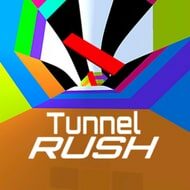
How far can you get in Tunnel Rush before the tunnel outpaces your reflexes? A first-person view flies you down a color-shifting tube, steering a marker through gaps before the walls close in. No story, no checkpoints, just distance in meters.
Dodging in Tunnel Rush Without Overcorrecting Every Turn
Your marker sits on a ring inside the tunnel, and tapping left or right slides it toward the next gap. The tunnel rotates and shifts color, so the gap is rarely where your eyes expect it.
New players crash the same way: they hold a direction key through a turn, and the marker sails past the gap into the next wall. Overcorrecting kills more runs than raw speed does.
The fix most regulars land on is parking the marker near the middle by default, since a central spot needs only a short tap either way, while sitting at one edge demands a full sweep for every second obstacle.
- Keep the marker centered between obstacles instead of hugging one edge
- Tap in short bursts rather than holding a direction
- Commit to a rotating wall’s gap early instead of adjusting mid-spin
How the Obstacle Walls Escalate as Speed Builds
The game leans on three recurring obstacle shapes rather than an ever-growing bestiary. Stacking two rotating obstacles close together is where most runs end.
- Rectangular bars blocking most of the ring except one notch
- Triangle-cube clusters that jut in at sharp angles, punishing slow reactions
- Semi-circular platforms that curve around half the tunnel, demanding a wider dodge
Past the first few hundred meters, obstacles stop sitting still and start rotating as they approach. Deep into a good run, two or three spin at once, and picking the right moment to commit becomes the whole game.
The escalation isn’t about new shapes, it’s about compressing reaction time on old ones. A bar at low speed gives nearly a full second to read the notch; in a faster zone that shrinks to a fraction, stacked behind a platform you’re still recovering from.
What Long Runs in Tunnel Rush Actually Teach You
Experienced players agree on one detail: the gap in a rotating wall is rarely where the color pattern suggests it is. Noticing that your eye tracks the color boundary rather than the real gap separates a run ending after a few hundred meters from one pushing past the four-figure range.
The all-time leaderboard sits past the 5,000-meter mark, though most players never get close, and that’s fine, since beating your own previous best is the only comparison that matters.
That local best-distance number is the whole scoring layer, keeping runs replayable in short sessions. There’s no unlockable content to grind, just the number from your last run daring you to beat it, and a single attempt rarely lasts more than a couple of minutes.
The Screen-Shake Question
Not everyone loves what makes the visuals so distinctive. Constant rotation, combined with saturated color bands shifting as speed increases, gives some players a genuine headache within minutes.
Some smoothing is built into the turn animation so the camera doesn’t snap instantly, softening the effect but not eliminating it for people sensitive to that motion. Playing in short bursts helps more than adjusting the controls does.
The flip side is that this same intensity is what regulars come back for, since a muted tunnel would lose the sense of speed that makes late-run dodging feel earned. Score-chasers shrug off the complaints, arguing the color shifts double as a pacing cue.
Tunnel Rush Questions Players Keep Asking
- How do you get a higher score in Tunnel Rush? Tap instead of holding the keys, keep your marker centered, and commit early to a rotating wall’s gap, since indecision causes more crashes than speed itself.
- Why does Tunnel Rush make some players dizzy? The tunnel rotates while its background shifts through saturated color bands as speed increases, a combination known to trigger motion discomfort.
- Does Tunnel Rush ever end or unlock new levels? No, just one accelerating run measured in meters, with your best distance saved locally as a race against your own record.
Tunnel Rush isn’t trying to be more than it is: a short, sharp reflex test in a spinning tube that gets meaner every few hundred meters. What keeps people coming back is that stubborn number from your last run, and the memory of which semi-circular platform caught you off guard.